
You can see it from the highway, from the HEB parking lot, from neighborhoods miles away. It rises stone by stone, spire pointing heavenward, and everyone watches. The open house is coming. The dedication will follow. The building will soon glow from within.
But here is what you cannot see from the highway.
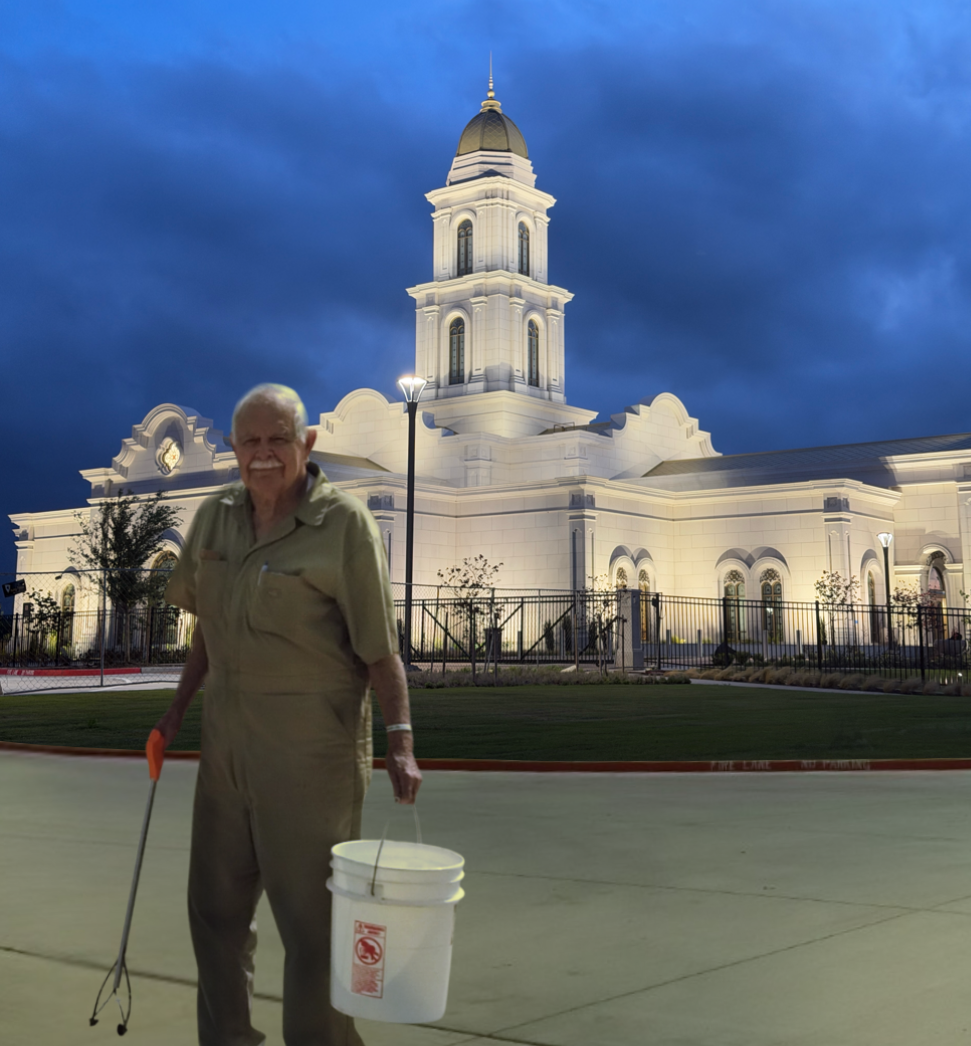
On Tuesdays, a man named Charles Willis drives to the temple site. He parks his car. He pulls on gloves. He picks up a grabber tool and a five-gallon bucket. And for the next several hours, he walks.
Three-quarters of a mile. Back and forth. Along the medians. Under the shrubs. Past the beautiful homes that sit adjacent to the temple property. He squeezes that grabber thousands of times. He fills bag after bag.
He has done this for almost two years. He has missed one Tuesday. That was the week he was in the hospital.
Charles does not work for the church. He does not work for the city either. He is just a man who made up his mind he wanted to serve—God, the temple, the neighborhood—and then found the proper way to do it. He sought out the city, signed a contract forty-pages long, spelling out every rule for his safety and theirs, and became an official volunteer. Now he wears bright colors so drivers see him. He stays alert because cars whiz past at forty miles an hour, missing him by about a foot.
He picks up what the construction crews leave behind. The little black plastic fences that barely stop anything. The Styrofoam. The bits of lumber, rebar, and wire that would otherwise blow into the neighborhood. He picks up what the wind carries in. What passersby toss out. Cigarettes. Tissues. Diapers. Things the grabber cannot handle, so his gloved hands must.
He does this for the temple, yes. Partly. But ninety percent, he says, is for the homeowners. The people whose hard work and sacrifice bought those beautiful houses. The people who did not ask for a construction site next door. The people who, for two years, have watched a holy building rise and, with it, all the mess that building leaves behind. He does not want their view to be Styrofoam and plastic scraps. He wants them to know the church is a good neighbor. Even if they never know his name.
In two years, one person has said thank you. One. More often, people cross the street when they see him coming. They turn and walk the other way. They treat him like a street cleaner. Like a janitor. Like someone beneath their notice. Charles keeps coming back on Tuesdays. He has thought a lot about why. About what keeps him going when the work is hard and the thanks never come. He wrote it down once, for anyone else who might want to help. Nine points. Three of them say everything.
Perseverance.
Each week brings new challenges, he wrote. The weather. The debris. The exhaustion. He pays for it the next day. Medicine helps him get up and function. But he gets up anyway. He goes anyway. The temple kept rising. So does he.
Ethics.
Around the temple, he said, your speech and your actions should be superb. Non-members may be judging your performance. He knows they are watching. He knows that every piece of trash he misses, every moment of impatience, every sigh could be the thing someone remembers. So he does it right. Even when no one is looking. Especially then.
Humility.
Your presence may be looked down on, he wrote. You may be treated like a street cleaner. He has felt it. He keeps walking. He keeps picking up. He remembers that the people crossing the street do not know why he is there. They do not know about the ninety percent. They do not know that their comfort, their view, their beautiful neighborhood is exactly why he comes.
And he does not need them to know.
Charles quoted a verse from Colossians. He wrote it down in his nine points. Chapter 3, verse 23, “Whatsoever you do, do it heartily as to the Lord and not unto men.” He added his own thoughts: I do have my heart into what I do for God, the temple, and the residents. God. The temple. The neighbors. All three. In that order. All connected.
He does not do it for praise. He has proof that praise does not come. He does it because the temple is rising, and someone needs to make sure the beauty of it is not lost in the mess of building it. He does it because the homeowners deserve a good neighbor. He does it because his heart is in it, and his heart, apparently, is big enough to keep going when no one notices.
The temple rises. You can see it from everywhere now. On Tuesdays, Charles Willis walks in its shadow. Cars fly past. People cross the street. The work never ends. He keeps walking. He keeps squeezing that grabber. He keeps picking up what the world drops and forgets.
The temple does not need his praise either. It stands there, stone and glass and spire, beautiful whether anyone thanks it or not. The beauty comes from what happens inside its walls. Charles Willis understands that. He has his own walls. They are made of Tuesdays and plastic bags and a grip so strong from thousands of squeezes he could probably bring most people to the ground with a handshake.
He does not, though. He just picks up the trash. Goes home. Takes his medicine. Comes back the next week. The temple keeps rising. So does he.
Written by: Amanda Gaertner, Burleson Texas Stake